
Apex Answers (Fact Checking)
The Town of Apex publishes a page answering questions it says residents are asking. We check those answers against the record — the documents, the votes, and the Town’s own data — and add each new topic as it appears.
Apex Answers (Fact Checking)
The Town of Apex publishes a page answering questions it says residents are asking. We check those answers against the record — the documents, the votes, and the Town’s own data — and add each new topic as it appears.
August 30, 2026
Since this page is dynamic and subject to change at any time, an archived screen capture is shown below. You can click on it to see the whole page.
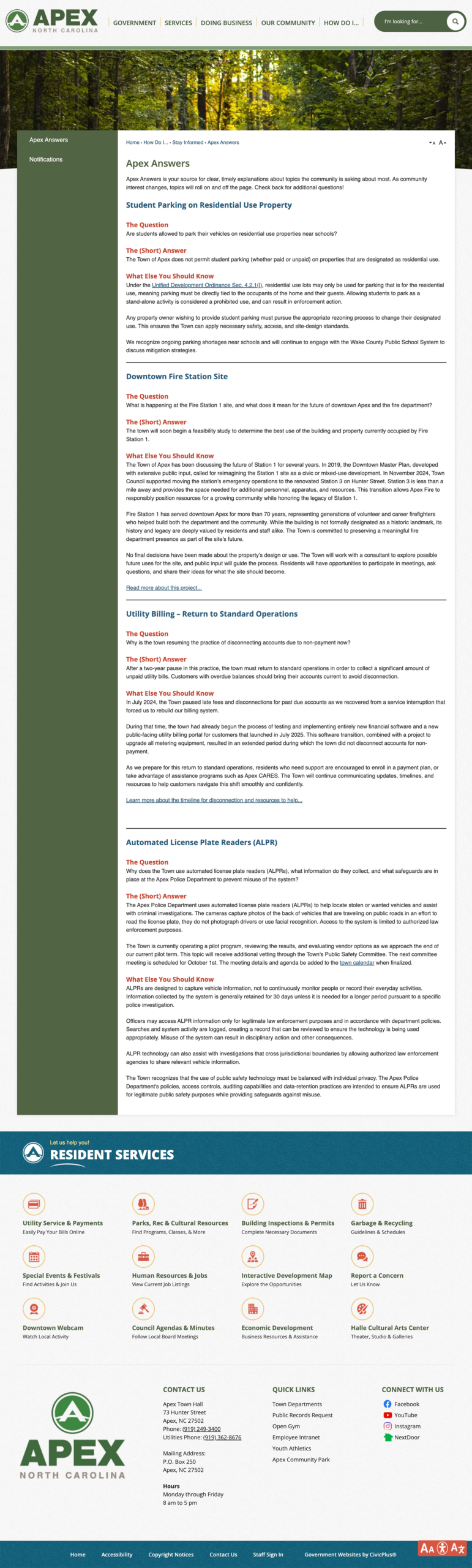
From the Town
Are students allowed to park their vehicles on residential use properties near schools?
The (Short) Answer
The Town of Apex does not permit student parking (whether paid or unpaid) on properties that are designated as residential use.
What Else You Should Know
Under the Unified Development Ordinance Sec. 4.2.1(I), residential use lots may only be used for parking that is for the residential use, meaning parking must be directly tied to the occupants of the home and their guests. Allowing students to park as a stand‑alone activity is considered a prohibited use, and can result in enforcement action.
Any property owner wishing to provide student parking must pursue the appropriate rezoning process to change their designated use. This ensures the Town can apply necessary safety, access, and site‑design standards.
We recognize ongoing parking shortages near schools and will continue to engage with the Wake County Public School System to discuss mitigation strategies.
The Fact Check
This is an incorrect description, wrong UDO section, impossible solution and lacks full context.
This answer states that the prohibition applies to, “properties that are designated as residential use.” The ordinance says something different. Section 4.2.1(I) sits in a section titled Prohibited Uses in Residential Districts. It applies by zoning district, not by what happens to be built on a lot. Apex’s Use Table — the document the FAQ links to — is organized by district: RA, RR, LD, MD, and so on. “Designated as residential use” is not a term in the Unified Development Ordinance.
This answer sites Section 4.2.1(I) as an oridinance which states what residential lots may be used for. In fact, it’s the opposite. It states what it may not be used for. The proper UDO section to support this statement is the Use Table in Sec. 4.2.2.
This answer says any owner wanting to provide student parking “must pursue the appropriate rezoning process.” Here is the problem with the advice. Section 4.4.5(E)(1)(a) requires that a commercial parking lot “shall be the principal use” of the property. Ms. Scott’s house is the principal use of her property. She has lived there since 1975. So rezoning alone does not solve it. She would first have to subdivide her 1.3-acre lot — survey it, split off the parking area as its own legal parcel, and satisfy minimum lot size, frontage, setback, buffer and stormwater standards on both halves. Then apply to rezone the new parcel. Then build to commercial standards: paving, curbing, striping, ADA spaces, landscaping, stormwater.
This answer fails to mention nonconforming use and statute of limitations. Miss Annie is protected from fines because she was already offering parking before the UDO amendment was made. She is also protected from a civil lawsuit because a municipality has 5 years to file suit and it’s been over 6 years since the amendment was added.
This answer states, “we will continue to engage with WCPSS.” Apex Friendship High School has 556 student parking spaces and roughly 100 students on the waitlist. The school district says 556 is the site maximum. The Town has had this in front of it for years. In August 2025 the Council declined a text amendment that would have addressed it. On November 13, 2025, Council member Brett Gantt moved to relinquish the property from the Town’s extraterritorial jurisdiction — to hand it to Wake County and step out of it entirely. That motion failed 2–3. Council members Arno Zegerman, Terry Mahaffey and Audra Killingsworth voted against it. Minutes later, the same Council voted 5–0 to direct staff to begin enforcement. “Continue to engage” describes a Town that has been offered exits and declined them.
From the Town
What is happening at the Fire Station 1 site, and what does it mean for the future of downtown Apex and the fire department?
The (Short) Answer
The town will soon begin a feasibility study to determine the best use of the building and property currently occupied by Fire Station 1.
What Else You Should Know
The Town of Apex has been discussing the future of Station 1 for several years. In 2019, the Downtown Master Plan, developed with extensive public input, called for reimagining the Station 1 site as a civic or mixed-use development. In November 2024, Town Council supported moving the station’s emergency operations to the renovated Station 3 on Hunter Street. Station 3 is less than a mile away and provides the space needed for additional personnel, apparatus, and resources. This transition allows Apex Fire to responsibly position resources for a growing community while honoring the legacy of Station 1.
Fire Station 1 has served downtown Apex for more than 70 years, representing generations of volunteer and career firefighters who helped build both the department and the community. While the building is not formally designated as a historic landmark, its history and legacy are deeply valued by residents and staff alike. The Town is committed to preserving a meaningful fire department presence as part of the site’s future.
No final decisions have been made about the property’s design or use. The Town will work with a consultant to explore possible future uses for the site, and public input will guide the process. Residents will have opportunities to participate in meetings, ask questions, and share their ideas for what the site should become.
The Fact Check
This answer says, “No final decisions have been made about the property’s design or use.” That is narrowly accurate on design and end use but materially misleading as written. The Town has separately committed on the record that the use will not be fire operations and has already approved relocating the department.
Further, the RFQ states that the building “is intended to be demolished.” Note the hedge word: the earlier version’s of the Town’s language said “no decisions have been made about the property’s use.” This version says “no final decisions… about the property’s design or use.”
This answer states, “Station 3… provides the space needed for additional personnel, apparatus, and resources.” Stated in present tense, and false in the present tense. Station 3 does not currently provide that space. Construction funding was only in the budget effective July 1, 2026, with construction slated for December 2026. The space is a $13.8M future purchase described as an existing asset.
This answer states, “”The Town is committed to preserving a meaningful fire department presence.” This word “meaningful” has a paper trail. September 2019: “maintain a fire presence downtown.” November 2024: “a meaningful connection to Apex Fire.” January 2026 RFQ: “a fire presence of some kind.”
From the Town
Why is the town resuming the practice of disconnecting accounts due to non-payment now?
The (Short) Answer
After a two-year pause in this practice, the town must return to standard operations in order to collect a significant amount of unpaid utility bills. Customers with overdue balances should bring their accounts current to avoid disconnection.
What Else You Should Know
In July 2024, the Town paused late fees and disconnections for past due accounts as we recovered from a service interruption that forced us to rebuild our billing system.
During that time, the town had already begun the process of testing and implementing entirely new financial software and a new public-facing utility billing portal for customers that launched in July 2025. This software transition, combined with a project to upgrade all metering equipment, resulted in an extended period during which the town did not disconnect accounts for non-payment.
As we prepare for this return to standard operations, residents who need support are encouraged to enroll in a payment plan, or take advantage of assistance programs such as Apex CARES. The Town will continue communicating updates, timelines, and resources to help customers navigate this shift smoothly and confidently.
The Fact Check
There is nothing in this response that appears inaccurate. The Town has resumed its standard billing operations.
However, it does fail to acknowledge that the billing audit results found errors in 100% of accounts and less than 1% of them were resolved when they ended the audit.
From the Town
Why does the Town use automated license plate readers (ALPRs), what information do they collect, and what safeguards are in place at the Apex Police Department to prevent misuse of the system?
The (Short) Answer
The Apex Police Department uses automated license plate readers (ALPRs) to help locate stolen or wanted vehicles and assist with criminal investigations. The cameras capture photos of the back of vehicles that are traveling on public roads in an effort to read the license plate, they do not photograph drivers or use facial recognition. Access to the system is limited to authorized law enforcement purposes.
The Town is currently operating a pilot program, reviewing the results, and evaluating vendor options as we approach the end of our current pilot term. This topic will receive additional vetting through the Town’s Public Safety Committee. The next committee meeting is scheduled for October 1st. The meeting details and agenda be added to the town calendar when finalized.
What Else You Should Know
ALPRs are designed to capture vehicle information, not to continuously monitor people or record their everyday activities. Information collected by the system is generally retained for 30 days unless it is needed for a longer period pursuant to a specific police investigation.
Officers may access ALPR information only for legitimate law enforcement purposes and in accordance with department policies. Searches and system activity are logged, creating a record that can be reviewed to ensure the technology is being used appropriately. Misuse of the system can result in disciplinary action and other consequences.
ALPR technology can also assist with investigations that cross jurisdictional boundaries by allowing authorized law enforcement agencies to share relevant vehicle information.
The Town recognizes that the use of public safety technology must be balanced with individual privacy. The Apex Police Department’s policies, access controls, auditing capabilities and data-retention practices are intended to ensure ALPRs are used for legitimate public safety purposes while providing safeguards against misuse.
The Fact Check
This answer states that the next Public Safety Committee meeting is scheduled for October 1st. It is actually scheduled for September 24. (withdrawn correction as they have now officially rescheduled it to October 1 at 3pm)
This question that the Town has posed to itself asks “what information do they collect” but fails to answer it. They describe that they take photos but do not describe the information collected.
Another question they have posed to themselves is, “what safeguards are in place?” The response, “misuse can result in disciplinary action…” and that policies are “intended to ensure ALPRs are used for legitimate public safety purposes” is also very vague and doesn’t directly answer the question.