
Last Updated October 21, 2026
What Happens When Apex’s Data Center Moratorium Expires?
The Town says it needs a year to write the rules for data centers. The rules it’s writing would make one easier to approve than it was the day the last developer walked away.
Last Updated October 21, 2026
What Happens When Apex’s Data Center Moratorium Expires?
The Town says it needs a year to write the rules for data centers. The rules it’s writing would make one easier to approve than it was the day the last developer walked away.
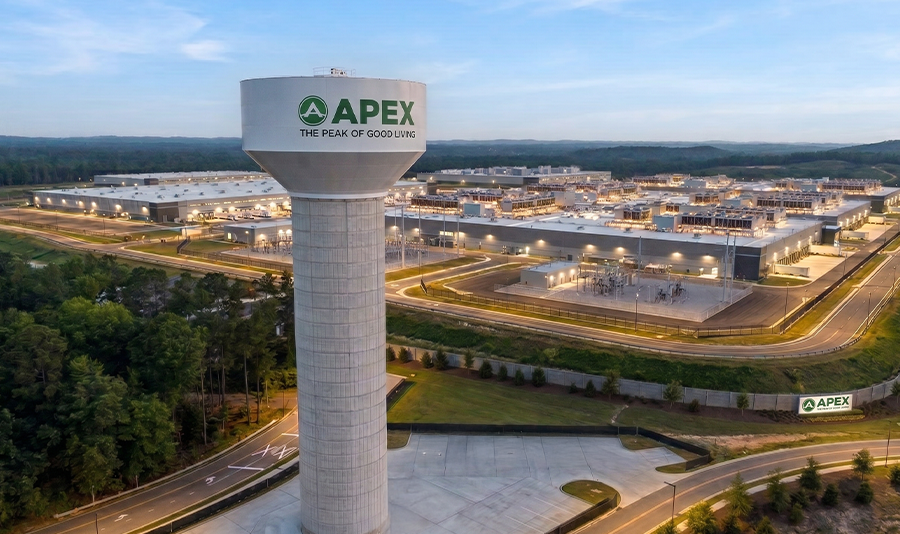
Last March, a developer with plans for a 300-megawatt data center on 190 acres of New Hill farmland walked away from Apex.
They didn’t lose a vote. They walked away from Apex’s development code that, by Natelli’s own account, would have had to change before it could build the data center.
In an email to WRAL News, Natelli investments said, “The town (Apex) continues its deliberations over zoning ordinance changes necessary to permit data center development within the town limits.”
They also told WRAL that they might return to Apex once the ordinances are updated.
Natelli added it would:
“Determine an appropriate course of action, if in the future, the town of Apex ultimately approves a comprehensive zoning text amendment allowing data centers as an approved use within the town’s limits.”
Now the Town is spending a year doing exactly what Natelli needs, and using their own framework to do it.
In Brief:
- The code already worked. Data centers have no category in Apex’s development code. Natelli Investments needed the Town to change the code to build one, and filed a request to do exactly that. Once Natelli withdrew, the simplest option was to do nothing: let that amendment die and leave the door shut. Instead, the moratorium exists to finish it, and Natelli has said that amendment is what it’s waiting for. And the working draft isn’t the Town’s. It’s Natelli’s own amendment, edited by staff and sent back to the developer, still carrying its law firm’s document number on every page. It adds a “P” to the Light Industrial column, which means permitted by right.
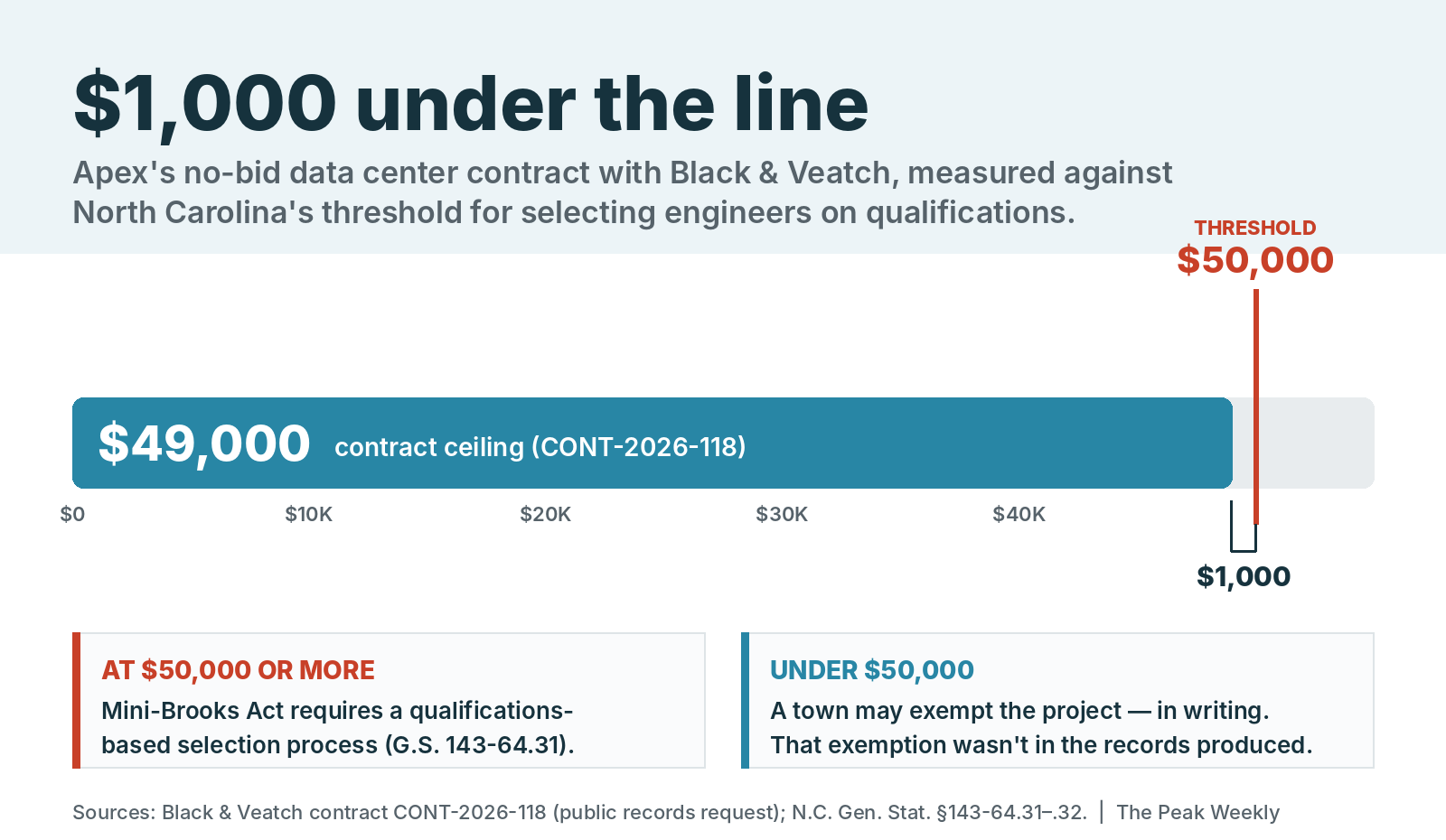
- A data center firm is helping write the rules. The Town hired Black & Veatch, whose corporate family includes a data center developer, under a no-bid contract set $1,000 below the line that would have required a competitive selection process. Records I obtained show the contract has no conflict-of-interest clause, and that the firm was advising Town staff for weeks before it was signed.
- The noise rules show how it’s going. The first noise rules were drafted, in staff’s words, while “coordinating with a prospective data center developer.” They were weak. The new draft is much stronger, but the numbers that matter most are still blank, and its toughest protections attach only if a developer agrees to them.
The moratorium expires April 27, 2027. Here’s what the Town’s own records say will be waiting on the other side.
What this article covers
Part 1: The Choice
The Code Held
The Apex UDO permits uses through a Use Table. Section 4.2.1 is explicit about what a blank cell means:
“A blank cell indicates that a use type is not allowed in the respective zoning district, unless it is expressly allowed by other regulations of this Ordinance.”
Let me show you an example. Here’s page one of the Use Table:
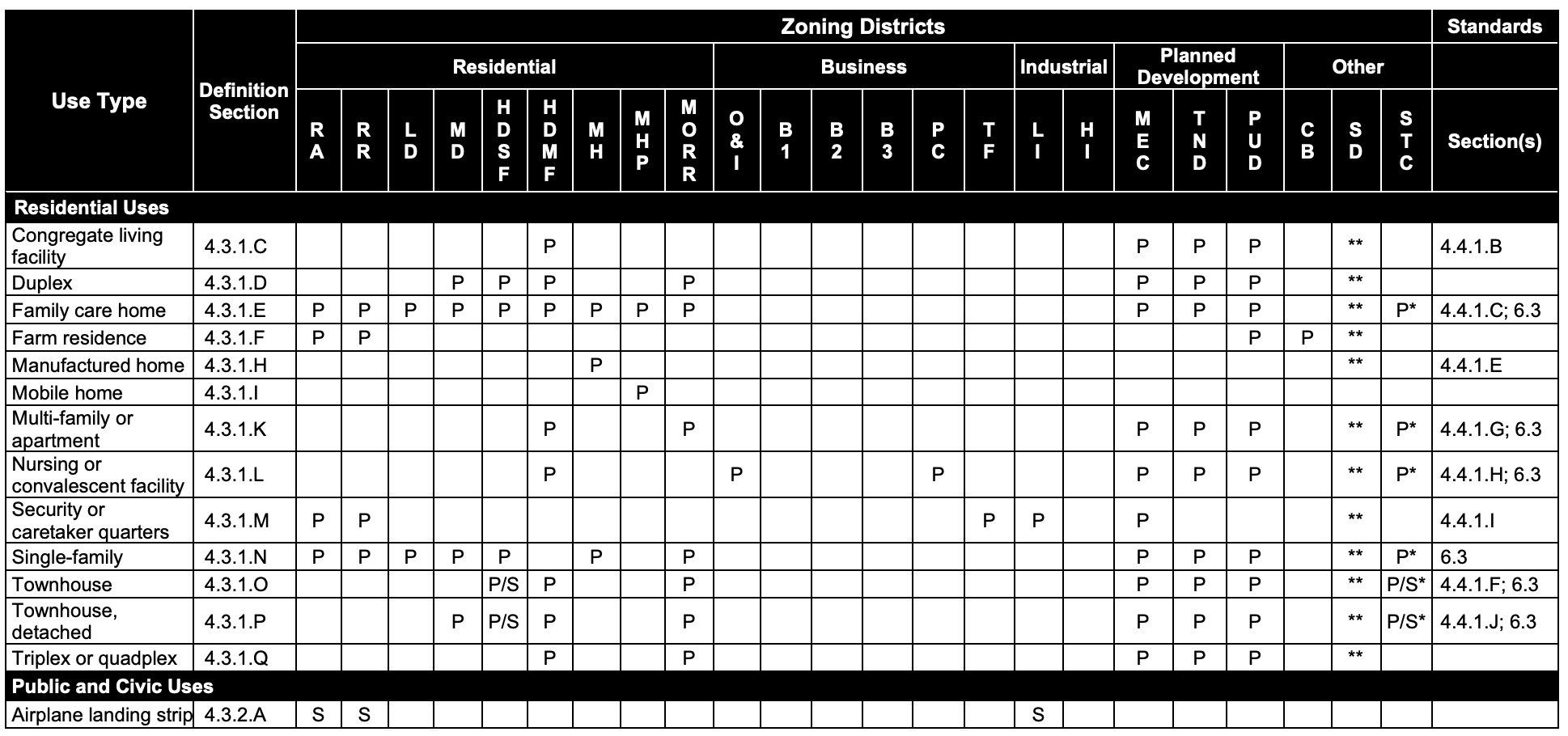
Look at the Farm residence Use Type, for example. That line shows a “P” under RA, RR, PUD, and CB. That means a farm residence is permitted, by right, in those four zoning districts. For the empty cells on that line, it means that farm residences are prohibited in those zoning districts.
Data centers aren’t in the table at all. In fact, there’s no category for them anywhere in the code.
That doesn’t make them automatically illegal. North Carolina’s Supreme Court has held that a town can’t simply ban every use its code fails to list. Apex’s code handles that with a window. Under Section 4.2.1(G) of the Apex UDO, “New or Unlisted Uses,” (like Data Center would be), the Planning Director “may approve the unlisted use” if its impact is “similar in nature, function, and duration to other uses allowed in a specific zoning district.”
So today, the only way a data center gets in is through one official’s discretionary call, on a record residents could appeal.
And that would be a hard call to make. The factors the Director has to weigh include “noise, odor, fumes, light, vibration, and emissions,” utility demands, “significant structures or facilities,” and the effect on neighbors. Apply them honestly to a hyperscale campus (hundreds of megawatts, industrial cooling, banks of diesel generators, a 1.5-million-gallon-a-day water draw) and “similar to other uses allowed in Light Industrial” is a stretch.
Natelli didn’t want to rely on that call. So they did something quite unusual.
They filed to change and rewrite our UDO to allow data centers so that their rezoning request would be a listed, permitted use rather than a judgement call.
This would make the rezoning vote look like council is just following the rules instead of making an exception.
On August 27, 2025, Natelli Investments signed an application, filed through its attorney at the law firm Fox Rothschild, to amend Apex’s Unified Development Ordinance.
The amendment was titled “UDO Amendment to Allow Data Storage Facility.” When they withdrew, Natelli pointed to the “zoning ordinance changes necessary to permit data center development.”
The developer’s own word. The door was closed, and the people trying to open it knew it.
The code even tells the Town what to do about a gap like this. The Director “may initiate an amendment to this Ordinance if … the lack of its inclusion or prohibition in this Ordinance would create public uncertainty.”
Inclusion or prohibition. The code expects the Town to settle the question one way or the other.
Keeping it closed is simple
The simplest option costs nothing. A UDO text amendment is a legislative decision.
What that means is – if anyone asks council to edit the Apex UDO, they can simply say no.
Natelli’s own application says so.
“Proposed amendments to the Unified Development Ordinance is a matter of legislative discretion of the Town Council.”
And data center development would need Apex to change its UDO.
But council has no obligation to adopt UDO change requests, and turning one down requires only a brief statement on whether the decision is consistent with the Town’s adopted plans.
Council could simply stop trying to rewrite the rules right now, and the code would stay exactly as it was the day Natelli walked away.
Instead, they are changing the UDO – the one thing in place that stops data centers.
If the Town wants to close even the Director’s discretionary window, it has tools for that too, and it has used them.
It could add “Data Center” to the Use Table with a definition and every district cell left blank, which shuts down the “similar use” argument.
It could add one line to Section 4.2.1(H), “Prohibited Uses,” the list of “hazardous or noxious uses” Apex bars from every district in town: abattoirs, acid and ammonia manufacture, explosives, creosote plants, junkyards, pulp mills.
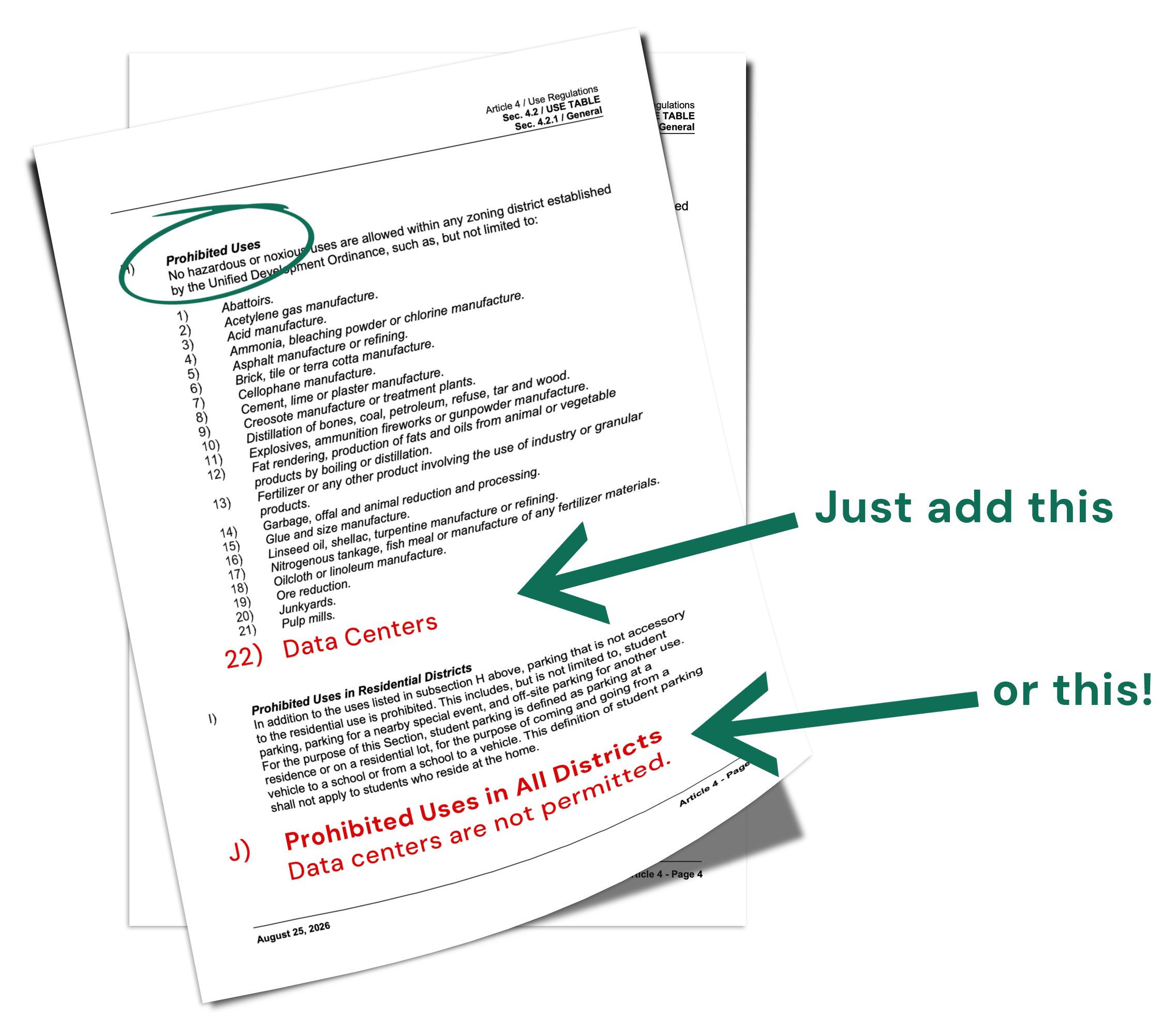
Or it could write a one-paragraph prohibition. That’s what the Town did when it wanted to stop a resident from renting overflow student parking.
The Town decided they wanted to prohibit non-accessory student parking, so they wrote a paragraph to block it. And now they’re using that paragraph to sue a resident. That’s how strong the Town views prohibited uses in its UDO.
So just repeat the process.
Define data centers, prohibit them, done.
What the Town is writing instead
The working document for the whole moratorium predates it by several months. The UDO draft version given to the data center subcommittee is titled “Draft UDO Amendment to Allow Data Storage Facility,” marked “Staff Suggestions DRAFT” and dated October 7, 2025.
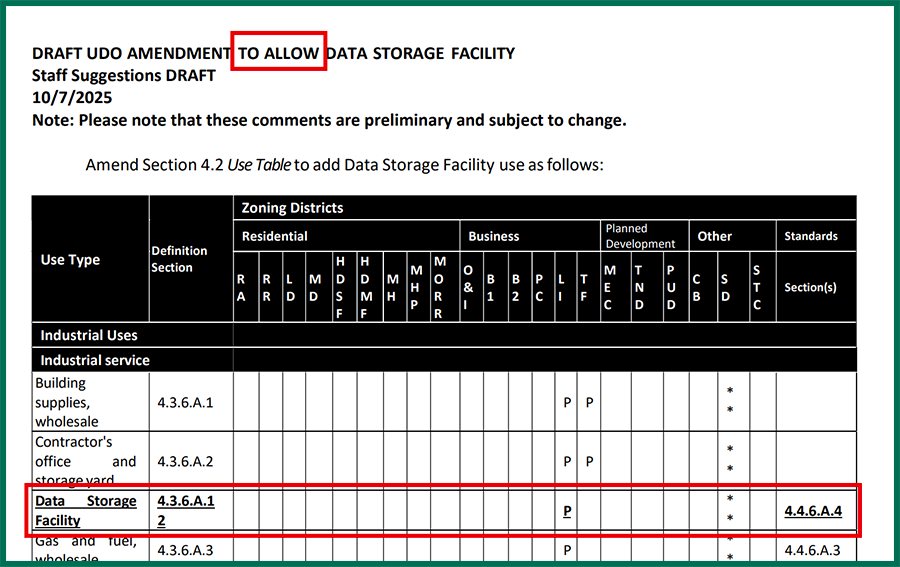
But the Town didn’t come up with that phrasing for its Draft UDO Amendment. Natelli did.
The file the Town posted is named “DRAFT Data Storage Facility Amendment Staff Edit 10-07-25 Sent to Applicant.” Every page of the amendment carries the same document number as the amendment Natelli’s lawyers filed in August: 174630513.3. The last four pages are Natelli’s own “Legislative Considerations,” the developer’s argument for why Apex should adopt it, attached unchanged.
That isn’t how the Town presents it. On the subcommittee’s document page, it’s listed simply as “Draft Data Storage Facility UDO Amendments 2025.” The residents reading that page aren’t told it began as Natelli’s petition, or that the developer’s case for its own project is still attached.
“The purpose of the moratorium is to give staff time to complete the UDO update we already started to include standards for data centers, free from the influence, pressure, or context of any specific pending application.”
Would it surprise you to find out that statement is false? The work staff and the data center committee is doing right now is literally working from a document created by a data center developer during their specific pending application.
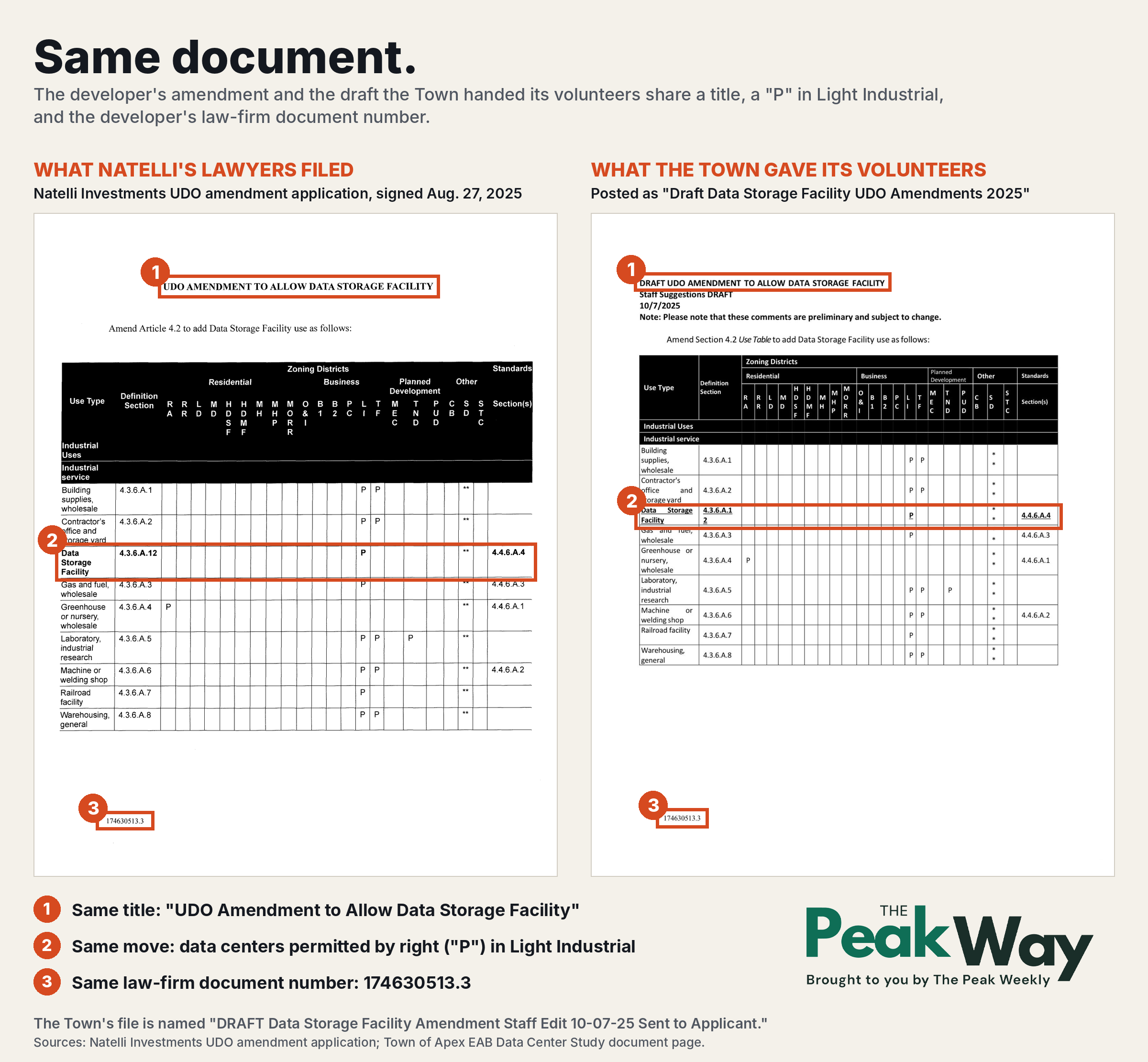
Its key move, in both versions, is a single letter. It adds a new “Data Storage Facility” use to the same Use Table and puts a “P” in the Light Industrial column.
Remember the farm residence example above? Empty cell means no. “P” means yes. No mention at all means Planning Director discretion. Apex’s draft adds data centers to the use table and adds a “P” (Permitted) to Light Industrial zoning districts.
Now as you go through the original definitions and specifics, there are changes to the staff’s version. Staff did real work on it, and they deserve credit for that.
Natelli’s version required buildings to sit only 100 feet from property lines, behind a 60-foot buffer, and for noise simply pointed to the Town’s existing noise ordinance. Staff’s edits added much more: nothing east or north of the NC 540 corridor; 1,320 feet between facilities; a 200-acre cap; 210-foot setbacks and a 200-foot opaque buffer; a 55 dB(A) noise limit with required studies; generators 300 feet back; fuel storage 1,320 feet from schools and hospitals; no groundwater for cooling; no potable water except in emergencies; pretreatment of discharge; efficiency targets; and a flat ban on small nuclear reactors. Several of those are genuinely tough. This is not a rubber stamp.
But staff kept the developer’s foundation: the title, the definition, the “P” in Light Industrial, the 100-acre minimum and the 75-foot height limit.
The developer left, but the document stayed. It was relabeled as the Town’s draft, handed to a volunteer subcommittee as the starting point for a year of work, and described by the moratorium’s sponsor as “the UDO update we already started.”
Where the draft came from
Council Member Terry Mahaffey met with Natelli Investments very early in this process.
As I reported in February, the Town’s Economic Development office convened a meeting on May 1, 2025, with Michael Natelli, Mayor Jacques Gilbert, Town Manager Randy Vosburg and Terry Mahaffey – four months before Natelli filed.
Mahaffey’s own newsletters lay out what happened next.
On September 4, 2025, days after Natelli submitted its application, he wrote that he had asked for an item on the Council’s Planning Committee agenda about “the use classification of Data Centers (Light Industrial) and a discussion about possible supplemental standards in the UDO for Data Centers.”
On September 29, he reported on that discussion: “We have a proposal from an applicant, which includes some standards – but are they appropriate for Apex? I asked staff to research.” That proposal was Natelli’s amendment. He added that the committee “agreed to hire a consult” to help write a sound standard.
On October 7, about a week after that report, staff sent their edits of Natelli’s amendment back to Natelli. It classifies data centers as Light Industrial and attaches supplemental standards, the two things he’d asked the committee to discuss.
On October 24, he called it “a pretty substantial update to our UDO” and said he’d requested a January work session on it.
On October 30, he relayed the Town Manager’s timeline for the data center: “Work session on the UDO amendments in January, likely a second neighborhood meeting in February, and March at the earliest for Planning Board/Town Council votes.”
As another reminder, this whole process was completely unnecessary. Mahaffey’s version shows how involved he is with guiding the UDO amendments, as if that’s somehow protecting Apex. All Council had to do was say no to changing them from the very beginning.
The application, the exposure, and the pivot
On February 22, 2026, I published an article reporting that the Town Manager had signed a nondisclosure agreement with the project’s unnamed end user, and matching its terms to Amazon agreements in other jurisdictions.
When I was able to make that connection, I knew it was the end of this particular data center application.
I wrote:
“This data center won’t get built. It’ll never happen.”
Eleven days later, Natelli withdrew.
Am I psychic? Lucky guess? No. I just pay attention and look at facts.
That’s how these deals work. End users don’t want residents to know who they are before the shovel hits the dirt. Once this one was exposed, the odds of building here went to slim and none.
Natelli wasn’t starting over in Vance County. It was already there. In December 2025, while its Apex application was still pending, Vance commissioners rezoned two parcels for Natelli totaling about 72 acres. On April 20, six weeks after Natelli left Apex, they approved the last piece, about 40 more acres.
In September, it filed plans there for a 900-megawatt, 528-acre campus, roughly three times the size of what it proposed here.
Just like Mahaffey said at the time: “They had an aggressive timetable.”
So when Apex was taking too long to change its UDO for them, they took the easier door in Vance County.
Either way, Natelli didn’t close the door behind them. They left a note on it: approve “a comprehensive zoning text amendment allowing data centers,” and they would reconsider Apex.
A few days later, Mahaffey moved for a moratorium to work on… a comprehensive zoning text amendment allowing data centers.
He praised himself for it. Many residents did the same. But the moratorium didn’t stop the data center. Natelli was already gone. And we still had nothing in our UDO which would allow Data Centers anywhere in Apex.
So what was the moratorium really for? On March 12, Mahaffey wrote that it would “give staff time to complete the UDO update we already started to include standards for data centers…”
The moratorium took effect April 28, 2026.
If the draft is adopted as written, our UDO will have what Natelli said it needed.
Seven meetings later, the map hasn’t moved
Council handed the work to a five-member volunteer subcommittee of the Environmental Advisory Board. It has met seven times, and the record shows real effort. Members have pushed for a Heavy Industrial district instead of by-right Light Industrial, and for bigger setbacks. Staff tightened the water efficiency target from 1.25 to 0.5 or lower.
But on the question the whole year exists to answer, where a data center can go, nothing has changed from the October 2025 draft. The NC 540 line, the acreage band, the separation distance, the setbacks and buffers are all the numbers written while Natelli’s application was live.
So then let’s look at what the location rules leave open. Staff’s draft keeps data centers out of everything east and north of NC 540: downtown, the established town and its existing industrial core. Add the 100-acre minimum and the Light Industrial requirement, and the realistic sites narrow to one place.
Using the Town’s own GIS data, I mapped every parcel or group of neighboring parcels of 100 acres or more on land the 2045 plan designates for industry, on the open side of 540. Of roughly 2,250 such acres, about two-thirds sit in the US-1/Old US-1 corridor toward New Hill, the corridor Natelli’s filing called “designated for Industrial Employment growth.” The realistic private sites are Natelli’s own and at least two other privately held tracts of 150 to 250 acres in that same corridor. The rest is a landfill, a utility plant, land committed to the Veridea development, and Duke Energy’s property around the Harris plant.
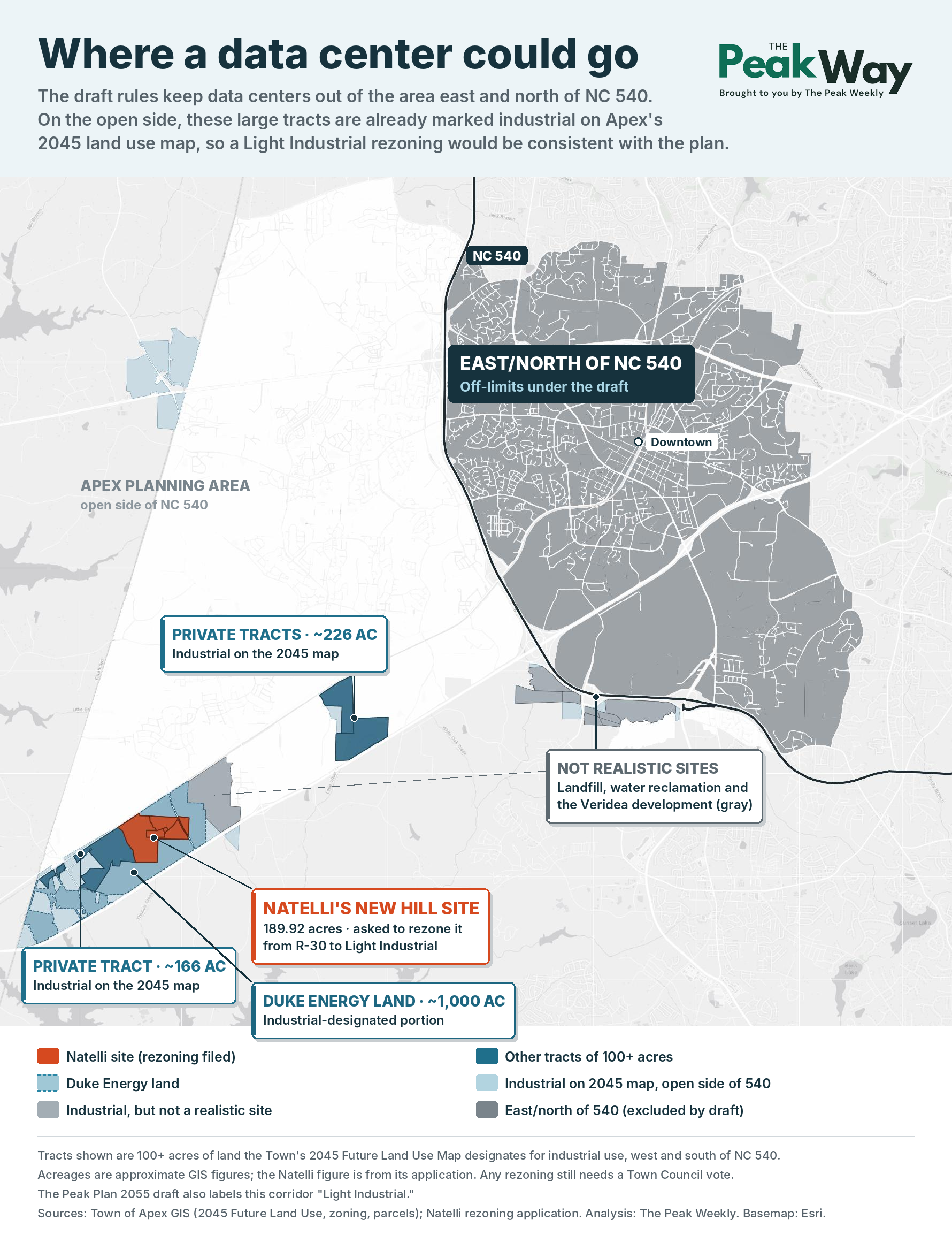
Natelli’s application shows how that consistency argument works. It covered four parcels on Shearon Harris Road, 189.92 acres zoned Wake County R-30, and asked to rezone them to Light Industrial-Conditional Zoning. Asked on the Town’s form whether the request was consistent with the 2045 plan’s “Industrial Employment” designation, Natelli checked “Yes.”
They knew what they were doing. The only thing in their way was the UDO. And if we just don’t touch it, it’ll remain in their way.
But on that point with the 2045 land map – we’re actually updating that soon. It’s not finalized, but documents show that the next plan points the same way. The draft map for Peak Plan 2055, the Town’s new comprehensive plan, shades that corridor from Harris Lake to New Hill Holleman Road as “Light Industrial,” the same name as the zoning district where the data center draft puts its “P.” Review drafts are expected November 12. Adopt both as drafted, and rezoning the corridor for a data center becomes, on paper, exactly what the Town planned.
The economic case hasn’t moved either. Natelli’s Legislative Considerations pitched community need, “high paying technology jobs” and a stronger tech “eco-system.” To its credit, the Town’s January 2026 staff report pushed back, citing Virginia research that data centers “generate relatively few long-term jobs, providing limited employment benefits to the local area.”
But the jobs pitch was back in Economic Development Director Joanna Helms’s August presentation to the subcommittee. The Sage Policy Group analysis Helms presented projects roughly 100 permanent jobs for more than $1 billion in investment. The jobs pay well, but there are very few of them per acre.
What hasn’t appeared is the cost side. Among the roughly fifty questions Council and the Planning Board raised in January was this one: “Analyze the potential economic strain on a city due to providing services for a data center.” No cost-of-service analysis has been presented.
The $4.13 million annual property tax figure has never been netted against a dollar of emergency response or infrastructure cost, and it’s a year-one figure for equipment the same deck shows depreciating to 5 percent of its value within five years.
And nobody appears to be tracking which of the fifty questions have been answered. Subcommittee member Suzanne Mason asked for that tally on August 5. No records show that it has been provided.
Meanwhile the subcommittee is shrinking. Two of its five members are gone, and staff said in September that the terms of two of the remaining three, John Garrison and Suzanne Mason, expire in December, just as drafting begins.
In his own words
The moratorium’s sponsor has written about data centers for more than a year. Here is how he has framed the question, in order.
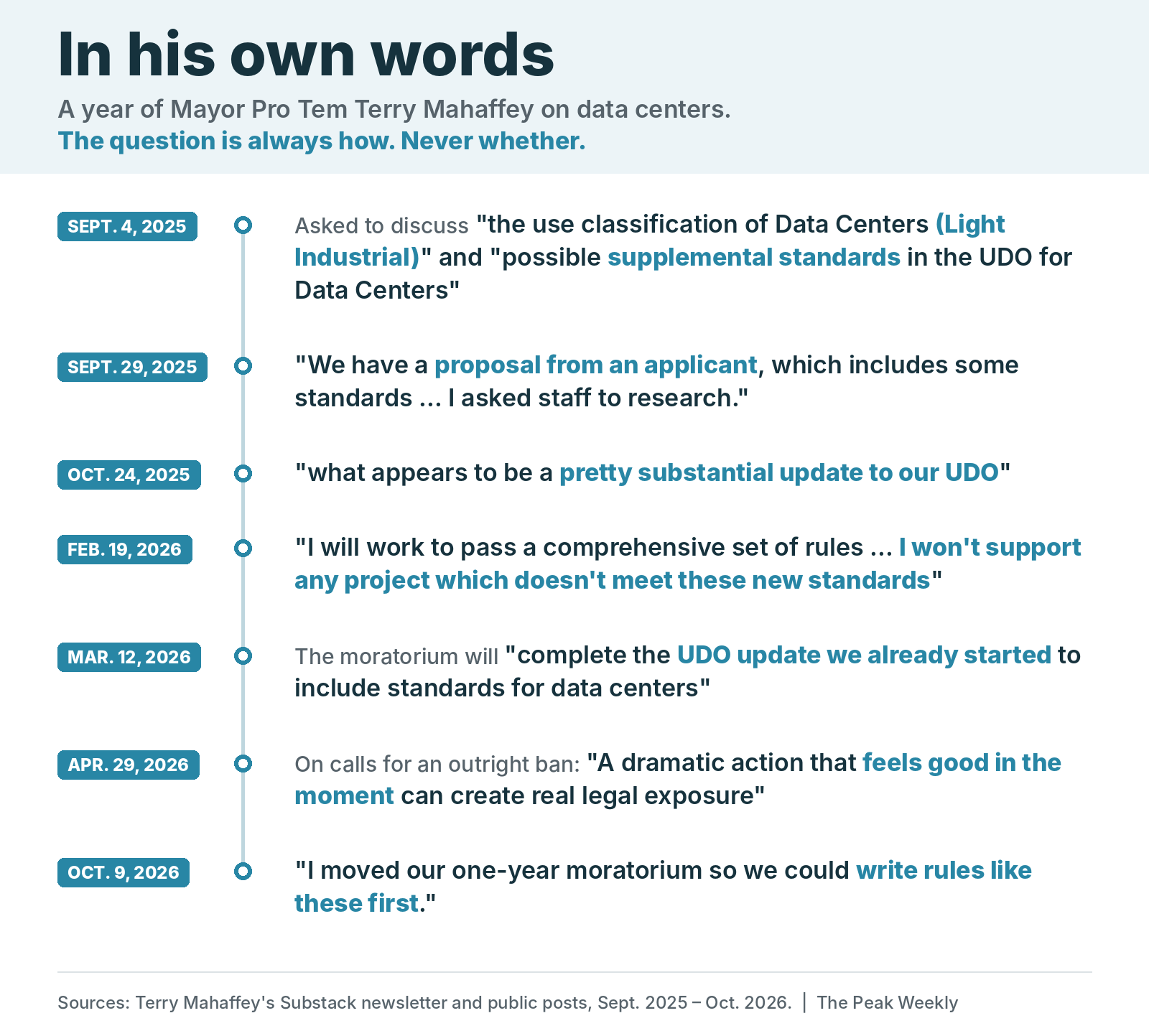
In every post I reviewed, the question is how to regulate data centers. Not once is it whether Apex should allow them.
Other towns chose to close the door
Apex isn’t the first town to face this.
In Peculiar, Missouri, the Board of Aldermen approved data centers the same way Apex’s draft does. They added a definition for data centers to their light industrial zoning.
After months of resident opposition, they voted 6-0 to remove it, which ended a $1.5 billion data center project.
In St. Charles, the City Council used a one-year moratorium to study the question, then voted in May 2026 to ban data centers.
That’s the difference. They used their moratorium to study the question. Apex is using its time to figure out how to alter the UDO to let data centers in. St. Charles’ study ended with a decision to ban them. The conclusion of Mahaffey’s Moratorium is going to invite them.
Part 2: The Consultant
Who’s helping write the new rules?
On February 16, 2026, the Town signed a professional services contract with Black & Veatch International Company for “engineering consulting work related to the study, evaluation, review, planning, design, and impact of a data center facility.” In the contract’s words, the scope includes “review of draft ordinances” and “review of submitted designs or plans for the construction of a data center.”
Read that second phrase again. The firm hired to help shape the rules could also be the firm that reviews a developer’s plans under them.
Remember a moment ago when I told you that Peculiar, MO removed their UDO amendment and turned away a developer? That developer was Diode Ventures.
Diode Ventures is owned by Black & Veatch. Black & Veatch is the firm Apex hired to help write its data center rules.
Black & Veatch is a global engineering firm that designs power, cooling and water systems for data centers, and it markets those services to data center developers and operators. Through Diode, it also develops and sells data center parks.
To be clear about what the record shows: there’s no evidence Diode has any interest in Apex, or that Black & Veatch’s development side has any role in this work. Those are questions, not conclusions. But a town hiring the regulated industry’s own engineering-and-development company to help write the regulations deserves plain questions.
I requested the contract and the Town’s correspondence with Black & Veatch. Here’s what the records show.
Black & Veatch has been one of Apex’s on-call engineering firms since 2018. It qualified through a competitive process in one category: water distribution and sewer collection. The data center work (noise, light, water, electric, community impacts, ordinance drafting and review, and construction-plan review) falls outside it.
North Carolina’s Mini-Brooks Act requires towns to pick engineers through a qualifications-based selection process. Under N.C. Gen. Stat. §143-64.32, a town can exempt a project, in writing, if the estimated fee is under $50,000.
The B&V contract ceiling is $49,000.
The written exemption the statute requires was not among the records the Town produced. I’ve asked for it specifically.
And the timing undercuts any argument that there wasn’t time to do it the normal way. Mahaffey wrote in September 2025 that the Council’s Planning Committee had “agreed to hire a consult” for sound standards. The contract wasn’t signed until February 2026, five months later. By then, the scope had grown from a sound standard to ordinance drafting, water, electric, community impacts and plan review, and the price had landed at $49,000.
No conflict-of-interest clause
The contract has none, even though Black & Veatch’s lead contact on the engagement runs a group that serves data center clients. That isn’t proof of a conflict. It’s the absence of anything that would catch one.
Hold that thought for Part 3. The Town’s own new noise draft requires exactly that kind of protection from its outside consultants.
The work started before the contract
From December 2025 into mid-January 2026, before any contract existed, Black & Veatch staff gave conference presentations, met Town staff for coffee, held a scoping call that included the firm’s acoustics lead, offered contacts at utilities in Loudoun County, Virginia and Columbus, Ohio, and stood by for Council’s January 22 work session. The pros-and-cons framing staff brought to Council that winter was developed with that informal input.
Black & Veatch signed the contract on February 12. The Town signed February 16. It runs to roughly February 2027, covering the whole moratorium.
Where’s the money?
I also obtained the Town’s vendor payment register from July 2025 forward. Every Black & Veatch payment in it is for waterline work, such as $23,500 on invoice 220212 for the Western Transmission Main. From the day the data center contract was signed through September 11, when the register ends, I found no payment under it. That’s seven months, under a contract that calls for monthly invoices.
That doesn’t mean the work was free. Invoices may be sitting unpaid, may have been billed some other way, or may have been paid after the register’s cutoff. But it means the public can’t yet see what $49,000 is buying. I’ve requested every invoice, progress report and deliverable under the contract.
Black & Veatch doesn’t appear in any of the subcommittee’s minutes. Its work shows up in staff email instead.
Compare that to what the volunteers are working with. At the October 7 meeting, new subcommittee member Kimberly Pierson, an electrical engineer, asked whether staff had reviewed ASHRAE 90.4, the industry’s energy standard for data centers. Staff said they couldn’t get a copy.
It costs $178.
Pierson offered to buy it herself, and member John Garrison noted the budget had “a tiny bit of money left.”
A $49,000 consultant whose work the public can’t see, and a volunteer board that can’t get a $178 standard…
Part 3: Drafting the Rules
The first draft
If you want to see the whole process in one place, look at noise. It’s the issue residents near New Hill have pushed hardest, and it’s where the records are clearest.
The October 2025 draft set the noise standard at 55 dB(A) at the property line, “or the existing conditions study maximum level, whichever is higher.”
Noise studies were to be sealed by a “Licensed Professional Acoustical Engineer (PE).” And the “third party” review of those studies would be done by a reviewer the data center itself “shall contract with.”
In April, staff wrote that they had drafted those noise conditions while “coordinating with a prospective data center developer.”
When that draft was written, the only data center application in front of the Town was Natelli’s.
The consultant’s review
Black & Veatch’s acoustics team reviewed that language, and the records show they found it weak:
- A 55 dB(A) limit measures the wrong thing. A-weighting discounts low-frequency sound, which is exactly the hum data centers make.
- “Whichever is higher” lets a site that’s already noisy set its own, higher limit.
- According to the firm’s reviewers, the license the studies had to be sealed under hasn’t been issued in about 20 years.
- It set no modeling standard and no test load, so nothing said what a study had to assume.
Planning, Water Resources and Black & Veatch met on August 7. Staff said they would document the outcome. I did not receive those notes in my record request.
The new draft
On October 7, planner Bruce Venable presented the subcommittee with a new, standalone Draft Data Center Noise Ordinance. He was candid about his limits: “I am not an engineer, a mathematician, or anyone who deals with some of these complex things.” No acoustician was at the meeting, and nothing from Black & Veatch’s acoustics review was in the packet, even though the Town has a consultant with an acoustics team under contract.
The draft itself is a different animal. Among other things, it:
- Measures low-frequency sound (dBC and third-octave bands down to 20 Hz), and says outright that “a facility can meet a dBA limit and still produce a hum that neighbors hear every day.”
- Closes the loophole: “A Baseline above a Table 1 limit does not raise that limit.”
- Takes the baseline study and compliance review away from the developer and gives them to a Town-hired, independent acoustical consultant, paid for by the developer.
- Requires modeling at full load, at night, downwind, with no credit for trees.
- Requires permanent monitors that report straight to the Town, with the data public.
- Forces re-testing after five complaints from separate households in 90 days, and says a complaint still counts even if the resident later signs a nondisclosure agreement.
It also says the Town’s acoustical consultant “may not have worked for the applicant, the Operator or an affiliate within the prior 3 years.”
So the Town is writing an independence rule for the consultants who will review data centers. But it didn’t put one in the contract with the consultant helping write the rules.
This is a serious draft and, again, Staff deserves credit. They are doing what they’ve been asked to do, and doing it thoroughly.
If Black & Veatch’s acousticians helped move the Town from the developer-coordinated version to this one, that’s to their credit too, and it’s one more reason their work should be public. The records I have don’t show who wrote it.
“I moved our one-year moratorium so we could write rules like these first.”
Rules like these, first.
There you go again. First. It’s never been about whether. It’s always been about how.
But read the brackets
Mahaffey’s own post put it plainly: staff “were clear that it’s a working document, not vetted by other departments, and every bracketed number is a placeholder.”
The draft says every number in [brackets] is “a policy choice” still to be made. The numbers that matter most are bracketed: the 40 dBA nighttime limit at homes, the 60 dBC low-frequency limit, and the 500-, 1,000- and 1,500-foot setbacks. The table meant to set hard nighttime ceilings for low-frequency sound reads “reserved.” The penalties read “$TBD.” There’s an optional clause that would let Council shrink the setbacks, which the draft itself labels “delete for maximum protection.” And emergency generator runs are exempt from the limits altogether.
Then there’s the part that ties all three parts of this story together.
The strongest tools in the package (an escrow account, a performance bond, a protocol to shut equipment down after a violation) are in an appendix written as conditions for a conditional rezoning. The draft says they “bind only if the petitioner consents to each one in writing.”
In practice, there’s almost nowhere in Apex a data center could go today without a rezoning. The big industrial districts west and south of 540 (the Apex Gateway park off US 64 and the Greenway Waste site) restrict their land to closed lists of uses, and data centers aren’t on them. The next data center would still come before Council.
But the draft changes what that vote looks like. Once data centers are a “P” in Light Industrial, and the Town’s plans label the New Hill corridor for industry, rezoning that land to Light Industrial looks like following the Town’s own plan.
That’s the exact argument in Natelli’s Legislative Considerations. And if a developer asks for a plain Light Industrial rezoning instead of a conditional one, the escrow, the bond and the shutdown protocol never attach. Council could still say no. It would just be saying no to something its own code and plan now call consistent. It hands the next applicant its best line: we followed every rule the Town wrote.
A strong noise ordinance attached to a permission the Town has pre-approved is still a permission.
What’s fair to say
The subcommittee’s meetings have been properly noticed, and recent ones are livestreamed and posted to YouTube. Staff have answered residents’ technical questions in writing, carefully, including on PFAS, where the honest answer is that neither the state nor the EPA has set enforceable discharge limits a town could apply. And the new noise draft shows staff can write protective rules when they set out to.
There’s also a legitimate case for regulating instead of banning: the tax base, the industrial-employment corridors in Advance Apex 2045, and the chance that the General Assembly preempts local data center zoning altogether. Reasonable officials can land on “permit it, tightly.” This piece doesn’t argue they’re wrong to consider it.
Not every elected official lands there. In late February, while Natelli’s application was still pending, U.S. Rep. Valerie Foushee, whose district includes New Hill, spoke out against data centers in Apex.
“Plainly, I don’t support a new data center in the heart of our district.”
There’s also the legal question, and it deserves a straight answer. An outright ban isn’t risk-free in North Carolina. Besides the Supreme Court ruling on unlisted uses, state law limits zoning changes that “down-zone” property without the owner’s consent, and the UNC School of Government says the reach of that limit is unclear. A 2026 law also lets developers demand binding interpretations of a town’s code and collect attorney’s fees if they win. No North Carolina town has adopted a permanent data center ban; every local action in the state so far has been a moratorium. Towns elsewhere have banned them, including San Marcos, Texas; Cumberland, Rhode Island; and East Lyme, Connecticut.
But that’s an argument against a ban. It isn’t an argument for permitting data centers by right. There’s a lot of room between the two. Council could decline the amendment and leave the code as it was. Or it could define data centers and allow them only through a conditional rezoning, so every project has to come before Council, Council keeps its power to say no, and the noise draft’s bonds and escrow actually apply.
That isn’t just my suggestion. The Town’s own January staff report noted that Virginia counties with heavy data center development have amended their codes “to limit by-right development (e.g., require conditional zoning, special use permits, etc.),” and listed “conditional zoning and developer agreements” among best practices. The draft still says “P.” It does neither.
What happened in Chatham County
The argument you’ll hear most from Council is legal risk. Mahaffey has made it repeatedly. In April he wrote that “a dramatic action that feels good in the moment can create real legal exposure,” and pointed to the lawsuit against Chatham County.
In September, after a judge ruled against Chatham, he wrote that Apex’s careful approach puts it “in a much better position” to withstand challenges like that one.
But it was a completely different scenario.
Chatham county adopted a data center moratorium in February. A developer sued, arguing that it had already been planning a data center on its property at Triangle Innovation Point West, a site it said was zoned to allow one, and that the moratorium couldn’t stop a project already underway.
The judge ruled for the developer and awarded attorney’s fees, with damages still to be decided.
Chatham’s problem wasn’t a ban. It was land a developer could argue was already open to data centers, plus a project in motion.
It’s quite literally a warning to Apex. If your code can be read to allow data centers, you can get sued for trying to stop them. The draft would remove any doubt about how Apex’s code reads.
Natelli itself showed how this works. Vance County had made data centers a use “by right with no additional requirements” in its Light Industrial and Office-Institutional districts back in February 2024.
When commissioners finally moved to pause them on September 14, 2026, their own moratorium ordinance spelled out the bind: any new rules had to be written so they “do not downzone any permitted uses nor create any non-conformities,” and the pause couldn’t touch applications already filed or rights already vested. According to residents tracking the case, Natelli had filed for vested rights five days earlier, along with its own redlined version of the county’s development code.
That’s the lesson for Apex. Once a town writes a “P,” state law makes it very hard to take back.
A developer that writes its own code amendments and races to lock in the old rules is exactly the kind of developer that land pre-approved for data centers rewards.
And the specific danger Mahaffey describes, a moratorium or rule change colliding with a pending application, doesn’t exist in Apex today. Natelli withdrew. Nothing is pending. By his own reasoning, there will never be a cleaner moment to decide the question than right now.
A year of noise studies, water reports and health research has kept nearly everyone, including the residents fighting hardest, arguing about how a data center should operate in Apex. Almost no one has been asked whether one should, a question that has been framed as economic development since the first meeting with the developer in May 2025.
And that question was already answered once, last March, by the code as it stands.
This piece argues that it’s a choice, and that residents haven’t been told it’s one.
So what happens on April 27, 2027?
When the moratorium was adopted, state law (N.C. Gen. Stat. §160D-107(d)(1)) required the ordinance to say what alternatives the Town considered and why it rejected them. The ordinance says alternatives were weighed and none were adequate. It doesn’t say whether the simplest alternative, declining Natelli’s amendment and leaving the code as it was, was one of them. Or whether “define it and prohibit it,” the tool Apex used on student parking, was.
And under §160D-107(e), the moratorium can’t simply be extended. The subcommittee’s calendar puts final review on March 3, 2027, eight weeks before expiration.
If nothing changes, here’s what will be waiting on April 27: a use table with a “P” marking Permitted for data centers, location rules written while a developer’s application was live, a noise ordinance whose key numbers are still being negotiated, and an engineering firm from the data center industry that helped shape all of it, hired without competition and without a conflict-of-interest clause.
Today, a data center needs one official to make a stretch of a call that residents could appeal. Last March, that was enough to send a developer home. After April 27, it would need a rezoning that the Town’s own code and plan call consistent.
Natelli told Apex what it would take to come back. On April 27, the Town may hand it over.
That’s not closing the door. That’s building a ramp.
Questions the Town should answer
Town Council meets October 27. These are the questions I’ve put to the Town through records requests, and ones any resident can raise during public forum:
- The subcommittee’s working document is Natelli’s own amendment, edited by staff and “Sent to Applicant.” After Natelli withdrew, why did the Town keep the developer’s amendment as the starting point for its own rules?
- Where is the written Mini-Brooks Act exemption for the Black & Veatch data center contract, and who signed it?
- What has Black & Veatch delivered, what has it invoiced, and what has the Town paid?
- Why does the contract have no conflict-of-interest clause, when the Town’s own draft noise ordinance requires one of its acoustical consultants?
- Will Black & Veatch, or any affiliate, be barred from reviewing a data center application under rules it helped write?
- Which developer did staff coordinate with on the original noise conditions, and will that correspondence be released?
- Will the Town release Black & Veatch’s acoustics review and the notes from the August 7 meeting?
- Natelli said it would reconsider if Apex approved a text amendment allowing data centers. Has anyone at the Town been in contact with Natelli, its consultants or its end user since the withdrawal?
- The draft Peak Plan 2055 map labels the US-1/Old US-1 corridor “Light Industrial.” Was that designation drawn with data centers in mind, and will the final plan say whether data centers belong there?
- Natelli is gone and no application is pending. Why not simply decline the amendment and leave the code as it is? And did Council consider that option when it adopted the moratorium?
All supporting documentation
Corrections: If you see something in this piece that’s wrong, reach out and I’ll correct it.
Town of Apex UDO 4.2 (Use Table)
The Town’s October 2025 Draft UDO Amendment
Draft Data Center Noise Ordinance (October 2026)
EAB Data Center Subcommittee Noise Presentation, October 7, 2026
All EAB Data Center Subcommittee Documents
My February 2026 Data Center Article
Peculiar, MO Minutes Removing Data Centers from Zoning, 6-0
St. Charles Passes a Ban on Data Centers (St. Louis Public Radio)
Apex Data Center Application Withdrawn by Developer (INDY Week)
Data Centers and Zoning in North Carolina (UNC School of Government)
San Marcos Council Votes to Prohibit Data Centers Citywide (CBS Austin)
Cumberland Council Bans Data Centers in 6-1 Zoning Vote (Uprise RI)
East Lyme Zoning Commission Bans Data Centers (WFSB)
Data Center Bans in NJ Draw $300M Developer Lawsuit (Scarinci Hollenbeck)
Data Center Developer Pulls Back from Apex, for Now (ABC11, March 7, 2026)
Natelli Investments’ UDO amendment application
Peak Plan 2055 Task Force Meeting 4 presentation, Sept. 1, 2026 (draft Future Place Type Map)
Town of Apex 2045 Future Land Use GIS layer
Rezoning ordinance #22CZ24, Apex Gateway Phase 1
Rezoning ordinance #23CZ15, Apex Gateway Phase 2
Rezoning ordinance #24CZ23, Greenway Waste
Rep. Valerie Foushee on the New Hill data center
Data Center Developer Seeking Rezoning in Vance (Henderson Daily Dispatch)
Vance Co. Board Approves Rezoning for Possible Data Center Development (WRAL)
Henderson-Vance FYI: Data Centers & Kerr Lake
Judge Rules Chatham County Data Center Can Proceed Despite Moratorium (NC Newsline)
Eco TIP West v. Chatham County, Summary Judgment Order (via Carolina Journal)
Black & Veatch contract CONT-2026-118
Mahaffey, Sept. 4, 2025: “Apex Town Council News”
Mahaffey, Sept. 29, 2025: “Apex Town Council Updates”
Mahaffey, Oct. 24, 2025: “Data Center Project Schedule, Apex Development Process”
Mahaffey, Oct. 30, 2025: “Apex Town Council News, November 2025”
Mahaffey, Feb. 19, 2026: “Let’s Talk Apex: Data Centers”
Mahaffey, Mar. 12, 2026: “Town Council Votes to Begin Data Center Moratorium”
Mahaffey, Apr. 29, 2026 – Facebook Post