
Last Updated September 8, 2026
Apex approved 800 homes and a daycare on its old sludge field. What is the Town doing about forever chemicals?
A homebuilder tested the ground and walked away. Nothing in the Town’s own process would have caught it — and nothing has changed since.
Last Updated September 8, 2026
Apex approved 800 homes and a daycare on its old sludge field. What is the Town doing about forever chemicals?
A homebuilder tested the ground and walked away. Nothing in the Town’s own process would have caught it — and nothing has changed since.
In Brief:
Between 2002 and 2012, the Town of Apex applied treated sewage sludge to farmland at Tingen Road and the Apex Peakway under state permit WQ0001060.
In January 2024, the Town rezoned that same 81.9-acre property for as many as 800 homes and a 15,000-square-foot daycare.
The Town’s 540-page decision record contains no reference to the site’s history, and its development application form contains no question about a property’s prior use.
Fourteen months later, a subsidiary of the homebuilder Lennar tested the soil and groundwater, found PFAS — the class of compounds known as forever chemicals — and terminated its contract. The seller and the intended buyer are now suing each other over $718,000 in escrow.
How did the land get zoned for 800 homes and a daycare if the soil contains PFAS?
That’s the thing: Nobody broke a rule. Nobody did anything wrong. And that is the problem this story is about.
What this article covers
First, what is sludge, and why do towns spread it on farms?
Wastewater treatment separates what goes down drains into cleaned water, which is discharged to a stream, and solids, which are not.
Treated further — digested, dewatered, tested for pathogens and heavy metals — those solids are called biosolids. Apex’s permit calls them “residual solids.”
They are genuinely rich in nitrogen, phosphorus and organic matter, and farmers have taken them for free for decades. On the Seymour fields the crop was fescue, grown for hay.
Every town produces them continuously and has to put them somewhere. Landfilling costs money. Incineration costs more. Land application costs least, and for most of the last forty years state and federal regulators actively encouraged it as beneficial reuse.

So Apex contracted a hauler — EMA Resources, Inc. of Mocksville — which found farmers willing to receive the material, got each field permitted by the state, and trucked it out. It was never a large operation. The permit authorized up to 1,649 dry tons a year; actual applications ran between roughly 110 and 580 tons annually in the years for which records exist.
The practice was not a loophole. It was the recommended approach.
North Carolina Cooperative Extension’s guidance on land application, first published in 1991 and last reviewed in June 2024, describes properly managed land application as “an excellent way to dispose of sludge,” and says such programs are designed so that, among other things, “future use of sludge-treated land for reasonable activities is not restricted.”
The concerns that publication enumerates are disease-causing organisms, heavy metals — lead, zinc, copper, nickel, cadmium, chromium, mercury — and nitrogen and phosphorus reaching surface water and groundwater. Each is addressed with a specific safeguard: pathogen reduction requirements, cumulative metal loading limits, soil pH adjustment, and setbacks including a prohibition on application within 100 feet of wells.
Every one of those safeguards was designed for a risk that was known. None of them were designed for PFAS. The 2024 revision of that guidance still does not mention it.
The vote
On January 23, 2024, the Apex Town Council voted 3-2 to rezone 81.9 acres at Tingen Road and the Apex Peakway for as many as 800 homes, a small commercial district, and a 15,000-square-foot daycare facility.
Planning staff had recommended denial. The Planning Board had recommended approval by a single vote, 5-4. The Council’s margin was equally thin.
The debate ran past eleven o’clock and covered traffic on Tingen Road, buffer widths along Salem Village, school capacity, tree canopy, and whether Apex Peakway would be widened to four lanes or three. Two councilmembers voted no. Both said they had wanted more trees and wider buffers.
What nobody discussed — because nothing in the Town’s record raised it — was that the Town of Apex had spent years trucking its own treated sewage sludge onto part of that land and spreading it there as fertilizer.
Fourteen months after the vote, Lennar Carolinas, LLC learned about the sludge, ordered testing, found PFAS, and walked away.
The outcome was fine. But that is not the same as a process that worked.
Nobody is living on that land. Nobody was harmed. But the Town approved 800 homes and a childcare facility without knowing what was in the ground, and it was a private company’s liability review — not any public process — that eventually asked.
Which raises the question this story is actually about: what is the Town of Apex doing about forever chemicals?
What went onto the Seymour farm
State records document the first applications in 2002. Monitoring pages filed with a 2003 permit application show material spread on seven of eight fields that year — 36.8 dry tons across three of the four Tingen Road fields, and 32.5 dry tons on a second Seymour property near New Hill.
The Seymours say in court filings that Thomas E. Seymour signed a land application agreement with the Town on or about April 23, 2003 — eleven months after those first documented applications. Whether an earlier agreement existed is not answered in the records reviewed.
Then comes a gap. The state’s file contains no per-field application records for calendar years 2003 through 2006.
From 2007 the records resume and are detailed. Across 2007 through 2015, the Tingen Road fields received material in exactly two years: about 25 dry tons in 2008 and 21 dry tons in 2010, across roughly 19 acres.
Total documented: roughly 84 dry tons over three application years. That is a conventional agronomic rate — the sort of application a farmer would make with any fertilizer.
This matters for how the story should be read.
This was not a dump site. It was a small, ordinary, state-permitted agricultural practice, of the kind carried out on more than a thousand acres across three counties by this one town, and on tens of thousands of acres statewide by dozens of others.
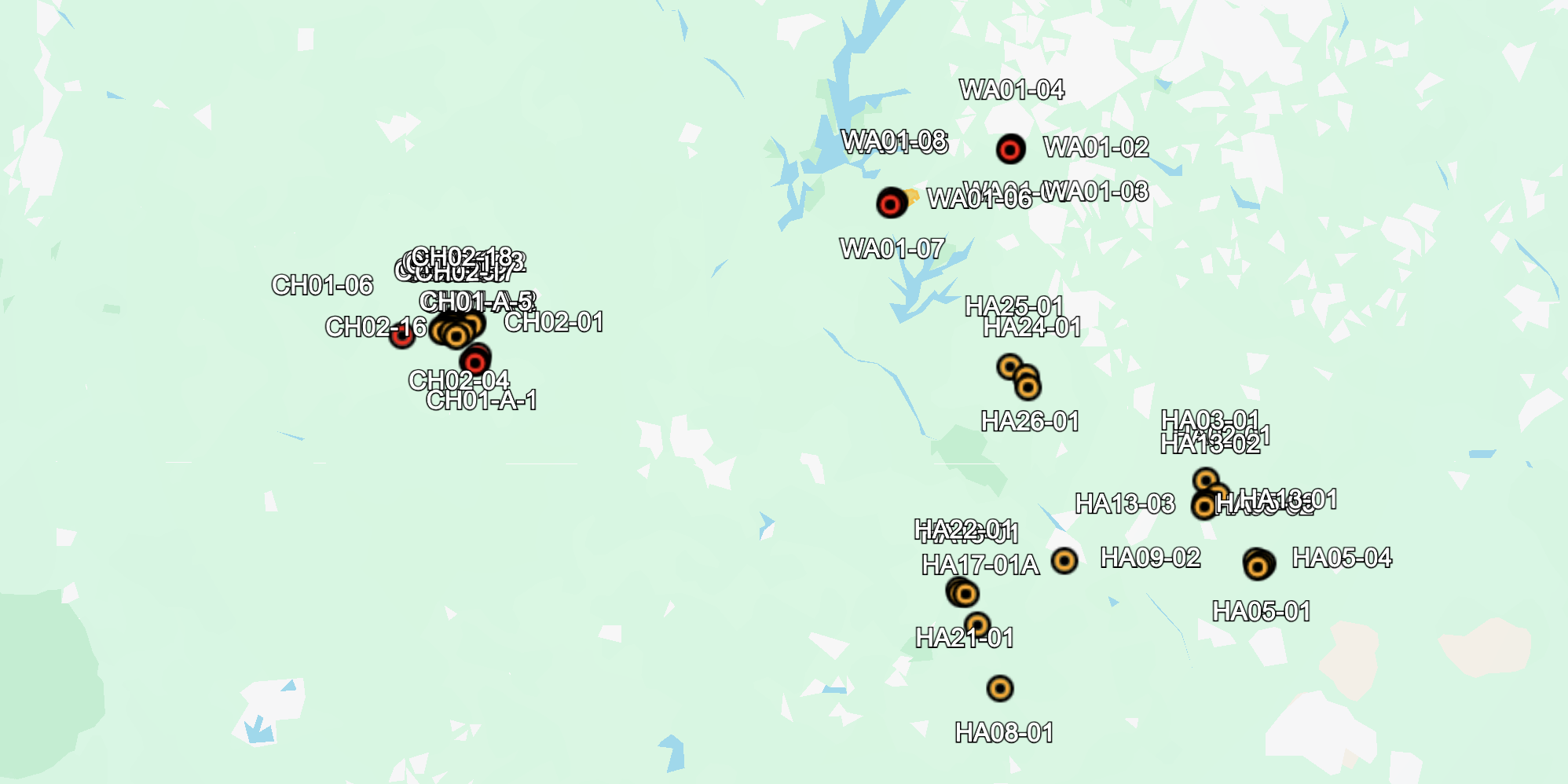
Above is a screen capture of each site where Apex’s sludge program made deliveries. You can interact with the map via Google Earth here.
Why nobody was looking for it
The practice was not a loophole. It was the recommended approach.
North Carolina Cooperative Extension’s guidance on land application, first published in 1991 and last reviewed in June 2024, describes properly managed land application as “an excellent way to dispose of sludge,” and says such programs are designed so that “future use of sludge-treated land for reasonable activities is not restricted.”
The concerns that publication enumerates are disease-causing organisms; heavy metals — lead, zinc, copper, nickel, cadmium, chromium, mercury; and nitrogen and phosphorus reaching water. Each is addressed with a specific safeguard: pathogen reduction requirements, cumulative metal loading limits, soil pH adjustment, and setbacks including a prohibition on application within 100 feet of wells.
Every one of those safeguards was designed for a risk that was known.
None was designed for PFAS. The 2024 revision still does not mention it.
Per- and polyfluoroalkyl substances are a family of thousands of synthetic compounds used since the 1950s in nonstick coatings, stain and water repellents, food packaging, firefighting foam and industrial processes. They are called forever chemicals because the carbon-fluorine bond at their core essentially does not break down.
They enter sewer systems from ordinary households and from any industry connected to the line. Wastewater treatment is not designed to remove them and largely does not. Most passes through with the discharged water; a fraction binds to the solids and concentrates there. Applied to farmland repeatedly, it accumulates.
“We don’t generate PFAS,” Ed Buchan of Raleigh Water told WRAL last year. “It just passes through our system and becomes concentrated in biosolids.”
In January 2026, the N.C. Department of Environmental Quality released results from its first study of PFAS in biosolids. PFOS, one of the most-studied compounds, was detected in every soil sample collected from fields where biosolids had been repeatedly applied.
There are no federal or North Carolina requirements to test biosolids for PFAS. And no soil cleanup standard for PFAS exists in North Carolina or federally. There is no number above which soil is legally contaminated.
What “it stopped years ago” doesn’t solve
Forty miles west of Apex, there is a documented case of what happens after land application ends.
NC State researcher Detlef Knappe measured PFAS in tributaries feeding Cane Creek Reservoir, the drinking water supply for Chapel Hill and Carrboro. One tributary came in at nearly 2,000 nanograms per liter; another around 800. Levels dropped to nearly undetectable moving away from the fields.
Those fields had received biosolids from Burlington’s wastewater plant, which historically had high industrial PFAS discharges. Application stopped years ago. Knappe told WRAL the contamination will continue anyway — the fields hold precursor compounds that break down into PFAS over time, and the runoff will persist “for decades or even centuries.”
OWASA’s public information officer was blunt about the source: all the PFAS in Cane Creek Reservoir comes from legacy land application that stopped several years ago, presumably from Burlington, on land OWASA does not own.
The Seymour property sits in a Secondary Watershed Protection Overlay District, draining to Big Branch Creek in the Harris Lake watershed, Cape Fear River basin.
No equivalent testing has been done there. Nobody has asked for any.
The rezoning, and what the Town’s record contains
Barnett Properties, LLC contracted in April 2023 to buy the property from the Seymour family for $300,000 an acre — roughly $24.6 million. It hired S&ME, Inc. for a Phase I Environmental Site Assessment. S&ME interviewed Tom Seymour on the property on April 25, 2023. According to Barnett’s later court filing, Seymour mentioned herbicides and pesticides. He did not mention the sludge. The Phase I identified no significant environmental issue.
The Seymours dispute that account. They say Seymour does not remember being asked about residuals, that he told Barnett’s vice president of development before the agreements were signed, and that the entire permit file was public and available to anyone who looked. Barnett denies being told. That dispute is being litigated.
Barnett filed rezoning case 23CZ13 on July 3, 2023. It went through nine rounds of Town staff review over seven months, two neighborhood meetings, a Planning Board hearing and a Town Council hearing.
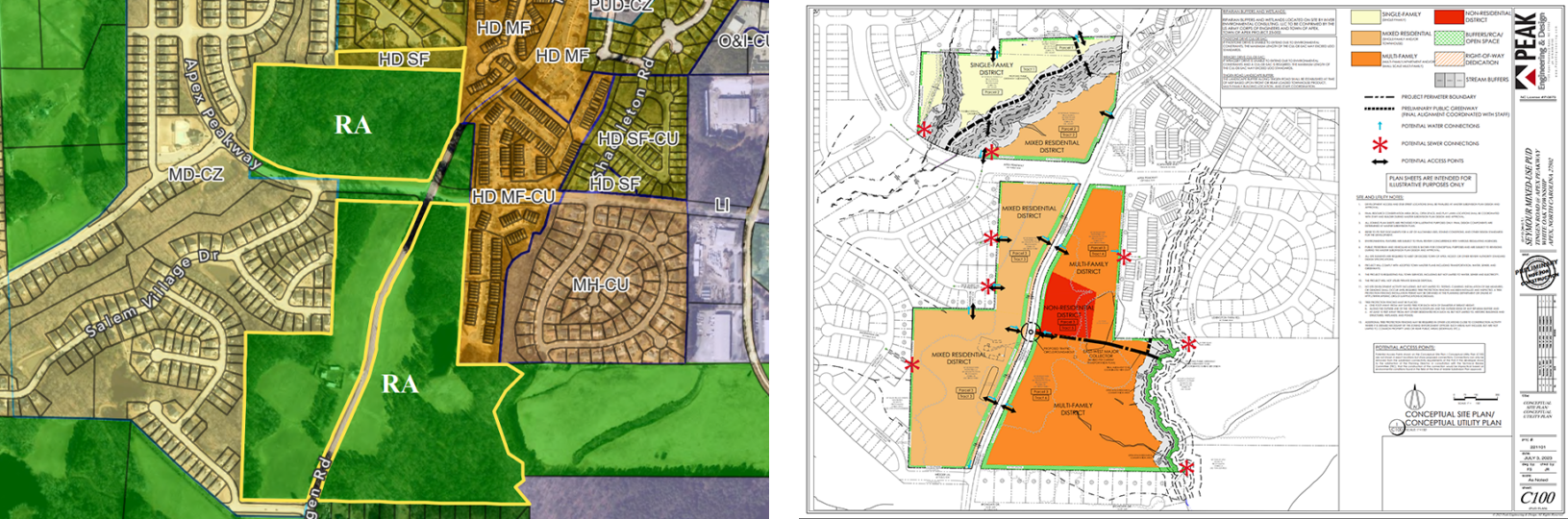
Residents raised stormwater. They raised drainage onto adjoining lots. They raised school capacity, traffic, tree removal, buffer widths and stub street connections. The Environmental Advisory Board ran the project through its full suggested-conditions checklist and recommended signage discouraging fertilizer use near stormwater ponds, pet waste stations, native plantings, a pollinator garden, and retention of topsoil on site.
The resulting decision record runs 540 pages.
Searched in full, it contains no occurrence of the words sludge, biosolids, residuals, land application, PFAS, contamination, groundwater, hazardous, or environmental site assessment. The 120-page rezoning application contains none of them either.
The Town’s own description of the property: “Partially wooded with open fields, farm pond, and a few existing buildings.”
Planning staff recommended denial, but not for anything to do with the land. The objection was that the applicant proposed a fee-in-lieu rather than building the Apex Peakway frontage to its ultimate four-lane section. The applicant eventually agreed to build the road, and the objection dissolved.
The written statement Council adopted three weeks later, Ordinance 2024-007, sets out the Town’s formal, legally required explanation of why the rezoning serves the public interest. It lists: widening Apex Peakway, widening Tingen Road, a roundabout, bike lanes, a side path, a sidewalk, a greenway, a possible traffic signal, a limited list of permitted commercial uses, reduced building heights, and increased buffer opacity.
Every item is a road or a setback.
The plan that was almost built
On August 1, 2024 — three weeks after contracting with Barnett — Lennar Corporation filed a Master Subdivision Plan with the Town of Apex in its own name, paying a $4,940 review fee. The application listed Stephen Dorn of Lennar as owner-developer and Jeff Roach of Peak Engineering as applicant.
The project had a new name: Tingen Corners (fka Seymour PUD).
The plan proposed 226 lots west of Tingen Road, 178 lots east, and 50,000 square feet of commercial space — roughly half the 800 units the rezoning permitted. Street names had been submitted to Wake County for approval. Astoria View. Nebula. Lily Arbor. Harper Creek.
Town review ran through the fall. Staff asked for critical root zones on preserved trees, cul-de-sac geometry, guest parking within 200 feet of every townhouse lot, legible fonts on the demolition sheets. Planning Director Dianne Khin intervened by email in November to rule that a zoning condition protecting riparian buffers superseded the ordinance, and that no buffer impact would be permitted.
One exchange in that file reads differently now. On October 2, 2024, asked to provide surveyed topography, Roach wrote:
“Lennar will be completing full topo of the property one they are through their Due Diligence period with the property owners (and the leaves fall off the trees).”
That due diligence period was open at the time. Within weeks, Lennar’s environmental consultant would take the soil samples that ended the project.
The last comment letter is dated November 21, 2024, and left 104 open issues. Lennar’s team packaged a third submittal on January 2, 2025.
On April 4, 2025, Lennar terminated.
Nineteen months later, nobody in the room knew
On November 10, 2025 — nineteen months after the rezoning vote and seven months after Lennar walked — the Apex Planning Board was reviewing a different project. Hopson Gateway, a 58-acre development a few hundred yards east, presented by attorney Matthew Carpenter of Parker Poe on behalf of Acre Management.
The Seymour property came up repeatedly, because Hopson Gateway depends on it. A road the Town wants runs through it. A sewer extension that Seymour’s builder had agreed to help pay for now falls almost entirely on Acre — roughly $4 million. And the traffic improvements the Seymour rezoning requires, including signalizing Tingen Road at the Apex Peakway, remain legal obligations attached to the land.
“Even though the builder who had the Seymour contract to come in with plans, they fell through,” Carpenter told the board, “the zoning conditions for the Seymour PUD are still in place. So if another developer picks up that site, they’ll have to signalize the intersection.”
Board members discussed how quickly it would sell. “It’s already zoned,” one said. “It’s not going to sit there.” Another: “When it does relist, it already being rezoned will go very quickly, in my opinion. That will not sit on the market long.”
Then a board member asked the obvious question.
“Can you provide a little input as to why Seymour never went through?”
Carpenter — the same attorney who had obtained the rezoning for Barnett Properties in January 2024 — answered:
“I don’t know the exact specifics, because I handled the zoning and then was out of it, you know, for the later process, but I knew that particular builder had some sort of issue during due diligence. That hopefully can be worked out by the next builder, developer. I’ve gotten questions about that site because it’s sitting in such a prime location and people see that it’s entitled. I don’t think there’s much of a better location than the Seymour site. They’ve just got to work through whatever the issue was.“
The board turned to Town staff.
“So is the staff aware of the issue with Seymour?”
“Just aware that the developer withdrew the application.”
A board member offered a guess: “I’m just wondering if these items like sewer would have made a difference.”
The chair closed the discussion.
Nineteen months after approving 800 homes and a daycare on land the Town had used for sludge disposal, and seven months after a national homebuilder tested the ground and walked away, this was the extent of what the Town of Apex knew about why.
The question the application form doesn’t ask
Apex’s Planned Unit Development application requires an applicant to address ten legislative considerations. Among them: whether the design minimizes environmental impact and protects against significant deterioration of water resources. Whether the proposal affects the health, safety and welfare of residents. Whether it constitutes a nuisance or a hazard.
The form contains no question asking what the land was previously used for.
That is the mechanism. Nobody concealed anything from the Planning Board, because the Planning Board was never in a position to ask. The Town’s utility department held a state permit naming this exact property. The Town’s planning department processed nine submittals on it. Nothing in the process connects the two.
It is also worth noting that a Phase I assessment under the ASTM standard reviews a defined set of environmental record sources. Non-discharge residuals land application permits are not among them — which may be why S&ME’s review found nothing.
That is the mechanism, and it held through every stage of the Town’s review.
The rezoning went through nine rounds of staff review over seven months. The subdivision plan that followed went through three more. Ten Town reviewers across eight departments worked the subdivision file — planning, stormwater, water resources, transportation, parks and recreation, transit, accessibility, development services. The final comment letter left 104 open issues.
Reviewed in full, that record runs to roughly 800 pages. Searched in full — including optical character recognition of the plan sheets that carry no machine-readable text — it contains no occurrence of the words sludge, biosolids, residuals, land application, PFAS, contamination, groundwater, hazardous, environmental site assessment, soil testing, prior use, or site history.
The word “environmental” appears once in the entire subdivision review, in boilerplate about wetland permits.
Nobody concealed anything from the Planning Board or from staff, because neither was ever in a position to ask. The Town’s utility department held a state permit naming this exact property. The Town’s planning department processed twelve rounds of review on it. Nothing in the process connects the two.
What Apex does now
The land application program has ended. According to the Town of Cary, Apex joined Cary’s regional biosolids program in 2010, sending its solids to a heat-dryer system at the South Cary Water Reclamation Facility. In 2014 a second drying system began operating at the Western Wake Regional Water Reclamation Facility, and Apex began transporting its solids there.
Those systems produce Class A Exceptional Quality biosolids — dried pellets, marketed as Enviro Gems and sold to a wholesaler as agricultural fertilizer. Class A EQ is the highest classification: pathogen-free, distributable to the public, reusable “without site restrictions.”
Heat drying kills pathogens. It does not destroy PFAS. The pellets carry the same compounds.
On May 23, 2014, the state renewed the permit effective July 1, deleting 32 fields including all eight Seymour fields, and cutting the program from 1,081 acres to 502.
So Apex no longer spreads liquid sludge on farmland. Its solids now leave as a product sold for agricultural use.
The questions that remain open
On the Seymour property. It is still zoned PUD-CZ for 800 homes and a daycare. No soil testing has been publicly disclosed. No concentration from Lennar’s assessment appears in any public record. If a developer files a master subdivision plan tomorrow, nothing in the Town’s process requires the history to surface.
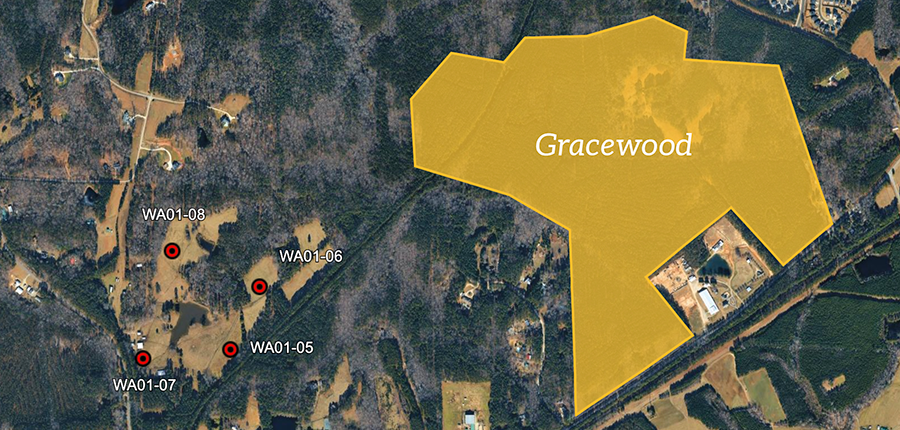
On the Gracewood development. It is being developed near the New Hill fields that also received Apex’s sewer sludge. I haven’t seen any evidence that this negatively affects the development, but are they aware of the nearby fields?
On the development process. Adding a prior-use question to the application form is one line. Cross-checking the utility department’s permit records against planning applications costs nothing; the Town holds both. Neither has been done.
On the spray field. In February 2026, the Council approved an annexation for Peak City Church including a six-acre spray-field on-site wastewater system designed to serve up to 850 people. Councilmember Shane Reese cast the lone dissenting vote, citing environmental concerns. Residents at that hearing raised PFAS specifically. A spray field operates under the same non-discharge regulatory framework as the residuals program described in this story — and under the same absence of PFAS standards. What monitoring will apply, who reviews it, and what happens to that land if it is ever sold are all unanswered.
On drinking water. Apex draws its water from Jordan Lake through the Cary/Apex Water Treatment Facility. Jordan Lake receives discharges from upstream municipal and industrial sources. What the Town’s PFAS levels are, and what it tells residents about them, is a separate question this story does not answer.
On the watershed. The Seymour fields drain toward Big Branch Creek and Harris Lake, inside a designated watershed protection overlay. Nothing downstream has been tested.
On the enforcement action. NCDEQ assessed the Town a $1,000 civil penalty on April 13, 2012, under case PC-2012-0011, against this permit. The underlying violation is not described in the records reviewed.
On what the Town did after April 2025, when a national homebuilder walked away from land Apex had rezoned fifteen months earlier.
On who is responsible. PFAS liability is being actively litigated in North Carolina, but not for anything resembling this. On September 4, a federal judge found Chemours and DuPont liable for PFAS from the Fayetteville Works plant entering the properties of class members without authorization, in a case covering more than 180,000 households. A jury trial on damages is set for March 4, 2027. That case involves a manufacturer, a specific plant, a defined class, and a legal theory — trespass — that requires no proof of intent to harm. The claims are largely for property costs rather than health effects: bottled water, filtration systems, replacing water heaters.
Land application has none of that structure. There is no manufacturer to sue. The material arrived by agreement, not by trespass. The compounds came from ordinary households and from whatever industry was connected to the sewer line. And there is no soil standard, so there is no threshold to have exceeded. A landowner whose fields received biosolids cannot test his way to clean, because no number exists that would clear the land.
Which leaves the question of who answers for it, and the current answer is nobody in particular.
And, lastly, on the sites outside of Apex, which received sludge and appear to be building homes on top of it now. Are they aware? Has testing been done there?
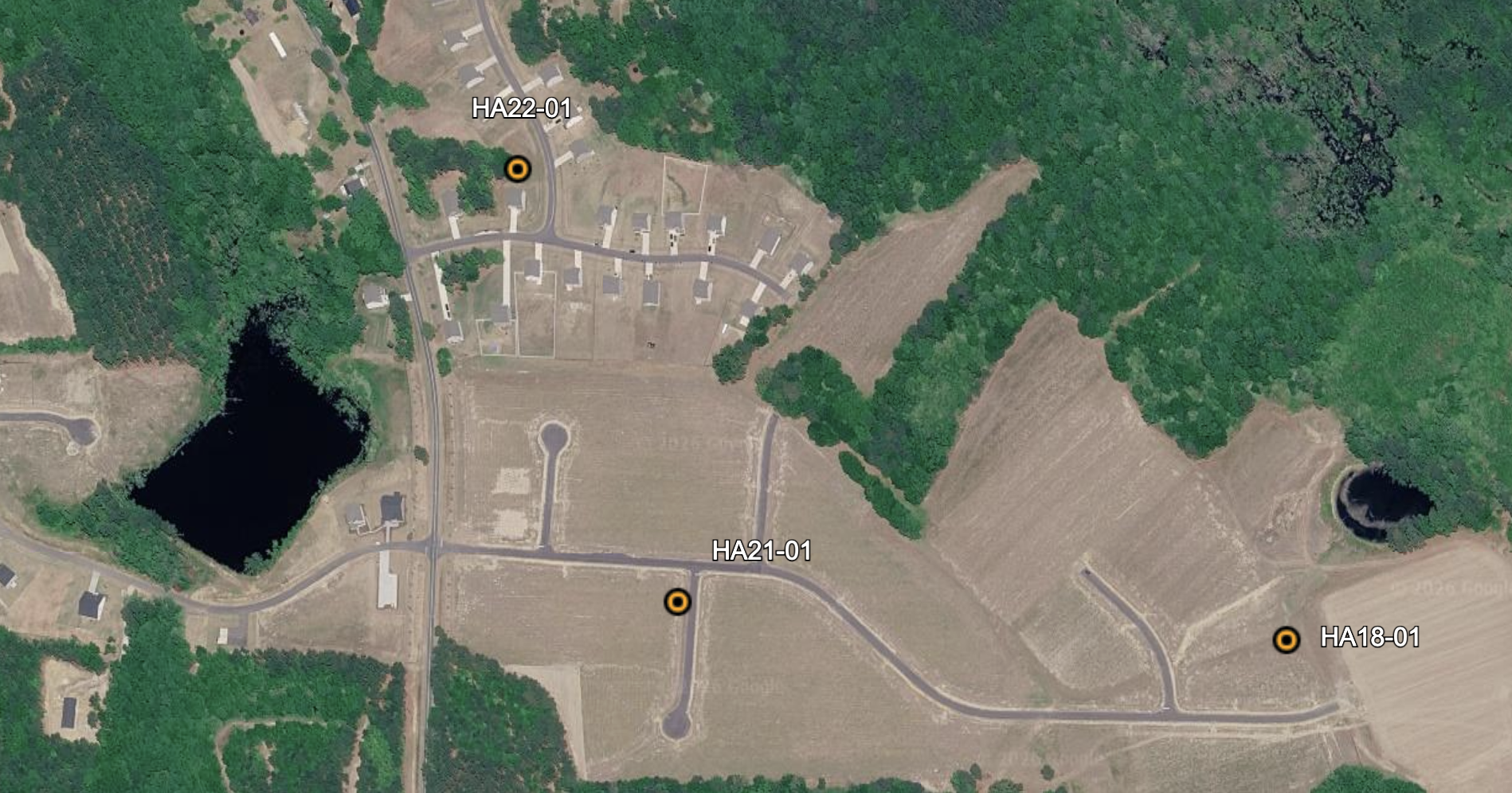
I am actively chasing down the answers to these open questions and will update the story as any new information becomes available.
What this story does not claim
That anyone at the Town knew. The record is silent. That is a demonstrable fact, and it is not the same as a demonstration that anyone stayed silent.
That the Seymour property is dangerous. Nobody can say that, because no concentration is public and no soil standard exists to measure one against.
That anyone acted improperly. The landowner accepted a state-permitted program his own town ran and the extension service recommended. The buyer hired a consultant and ran the standard assessment. The Town followed its ordinance. The state issued and renewed the permit.
Everyone did what was asked of them. The result was 800 homes and a childcare facility approved on ground nobody had thought to ask about, and it took a private company’s liability review to surface it.
The rules were built for a set of risks that were understood in 1991. The risk changed. The rules did not.